






Maybe you've thought about seeing a pelvic floor physical therapist.
And maybe you've also thought...
Do I really have to?
Maybe there isn't one near you.
Maybe your insurance doesn't cover it.
Maybe the thought of pelvic floor therapy makes you a little uncomfortable.
Or maybe you're simply wondering if there are things you can try at home first.
If any of that sounds familiar, I have some good news.
Yes, there are things you can do at home that may help improve bladder control — and pelvic floor physical therapy isn't the only place to start.
But (and this is important!) that doesn't mean physical therapy isn't valuable or that every bladder leak can be solved with a few Kegels.
So let's talk about what you can realistically do at home, why bladder leaks happen in the first place, and when getting some professional help really is worth it.
First, why am I suddenly leaking urine?
This is the part I wish more women were taught.
Your bladder doesn't work all by itself.
It has an entire support system around it — including your pelvic floor muscles.
Think of your pelvic floor like a little hammock at the bottom of your pelvis. These muscles help support your bladder, uterus and rectum, and they play an important role in bladder control.
Over time, things like pregnancy, childbirth, aging, chronic coughing, constipation and excess pressure on the pelvic floor can affect how well those muscles function.
That's why you might suddenly notice...
A little leak when you sneeze.
A dribble when you laugh really hard.
That oh no moment when you jump, run or lift something heavy.
Or the sudden urge to pee where you're practically speed-walking to the bathroom with your fingers crossed.
And while bladder leakage is common, especially as we get older, common doesn't mean you simply have to put up with it.
So... can you stop bladder leakage without physical therapy?
For some women, symptoms can improve with strategies they practice at home.
Pelvic floor muscle training is one of the conservative approaches commonly recommended for urinary incontinence, and these exercises can be performed on your own or with the help of a pelvic floor physical therapist.
The key words there are:
Performed correctly.
Because doing more Kegels isn't always the answer.
And that's where a lot of us go wrong.
1. Learn how to actually use your pelvic floor
If I told you to flex your bicep, you'd probably know exactly what to do.
Pelvic floor?
Not quite as obvious. 😂
A Kegel involves gently contracting the muscles you would use to prevent yourself from passing gas or urine, then fully relaxing them again.
The important part is making sure you're actually using the pelvic floor — rather than squeezing your butt, thighs and abs and hoping for the best.
And please don't repeatedly practice Kegels by stopping your urine stream while you're on the toilet.
Once you understand what the contraction feels like, pelvic floor exercises can be practiced lying down, sitting or standing.
And yes...
You can do them at home.
No fancy equipment required.
2. Don't forget the "relax" part
This one surprises a lot of women.
A healthy pelvic floor isn't just strong.
It also needs to be able to relax.
Think about your bicep again.
Imagine walking around all day with your arm permanently flexed.
Would you call that a healthy, well-functioning muscle?
Probably not.
Your pelvic floor is similar.
Constantly squeezing, bracing and doing hundreds of Kegels isn't necessarily better. Some pelvic floor problems can actually involve muscles that are already too tight.
That's one reason I don't love the blanket advice of:
"Just do Kegels!"
Bladder control is a little more nuanced than that.
3. Look beyond Kegels
Your pelvic floor doesn't live on an island.
It works alongside your core, diaphragm, hips and surrounding muscles.
Even your posture and breathing patterns can affect how pressure moves through your abdomen and pelvic floor.
So if you're trying to improve bladder control at home, don't think of it as simply squeezing one tiny set of muscles 100 times a day.
Think bigger.
Learning to coordinate your breathing, core and pelvic floor — especially during movements that normally cause you to leak — can be an important piece of the puzzle.
This is actually why I created Pelvic Floor Strong
Years ago, I became fascinated by how connected the pelvic floor is to the rest of the body — and how many women were being told to simply "do more Kegels."
That's ultimately what led me to create Pelvic Floor Strong.
It's an at-home program designed specifically for women who want to learn more about strengthening and supporting their pelvic floor without needing a gym full of equipment.
We focus on the bigger picture — not just endlessly squeezing your pelvic floor.
And that's important to me.
Because whether you use Pelvic Floor Strong or find another routine that works for you, I want women to understand that pelvic floor health is about more than Kegels.
4. Try bladder training
Here's another strategy that has nothing to do with doing more Kegels.
Bladder training.
If you're constantly going to the bathroom "just in case," you may get into a habit of emptying your bladder very frequently.
Bladder training involves gradually working toward more regular bathroom intervals rather than automatically running to the toilet every time you feel the first hint of an urge.
Keeping a simple bladder diary can be surprisingly helpful here.
For a few days, jot down:
- When you use the bathroom
- When you experience urgency
- When leaks happen
- What you were doing when you leaked
- What and how much you're drinking
You may start noticing patterns you never realized were there.
Maybe coffee is a big trigger.
Maybe leaks happen almost exclusively when you exercise.
Maybe you're using the bathroom far more often than you thought.
Information is power.
5. Pay attention to constipation
Yes, we're talking about poop now. 😂
But stay with me.
Regular straining can put additional pressure on your pelvic floor.
So if you're working hard on your pelvic floor exercises but you're also straining in the bathroom every single day, you're missing an important part of the picture.
Supporting regular bowel movements with appropriate hydration, movement and fiber can be part of supporting your pelvic floor too.
Sometimes the seemingly unrelated little things matter more than we realize.
6. Take a look at your everyday habits
This doesn't mean you need to overhaul your entire life.
But there are a few everyday factors worth paying attention to.
For some women, caffeine and alcohol can worsen bladder symptoms. Smoking and chronic coughing can also contribute to bladder-control problems. And carrying excess weight can place additional pressure on the bladder and pelvic floor.
That doesn't mean you need to give up your morning coffee tomorrow.
(I wouldn't do that to you. 😉)
It simply means that if bladder leaks are bothering you, it's worth noticing whether certain habits seem to make your symptoms better or worse.
What about supplements for bladder support?
This is another question I get a lot.
And I think it's important to make a distinction here.
A supplement isn't a replacement for strengthening and supporting your pelvic floor.
That's why I don't look at it as an either/or situation.
For me, it's about supporting the body from different angles.
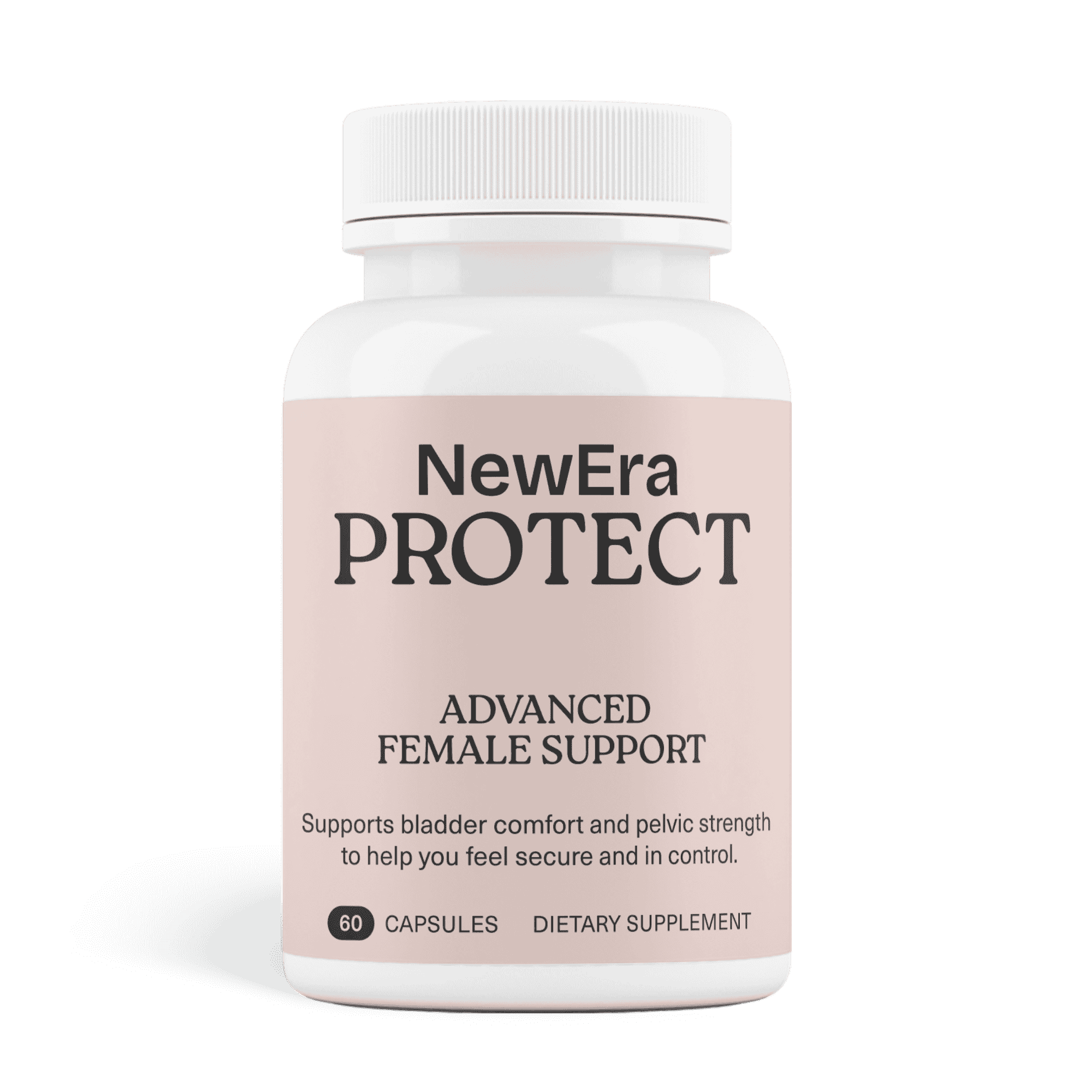
That's also part of the reason we created NewEra Protect.
Protect is our daily bladder-support supplement formulated specifically with women in mind. It contains ingredients including Crataeva, Horsetail, Japanese Knotweed, Sumac and Boswellia, along with Vitamin D3 and Zinc.
I think of it as an additional layer of bladder support alongside the everyday habits we're talking about here — not a replacement for pelvic floor exercise or appropriate medical care.
It's also why Pelvic Floor Strong and NewEra Protect make so much sense together in my mind:
One focuses on helping you learn how to support your pelvic floor through movement and exercise.
The other is designed to provide nutritional support for bladder health.
Two different approaches with the same bigger goal:
Helping women feel more confident and supported in their bodies.
How long does it take to strengthen your pelvic floor?
This is where patience comes in.
Pelvic floor exercises aren't an overnight fix.
Just like you wouldn't do ten squats tonight and expect completely different legs tomorrow, your pelvic floor needs time and consistency too.
Some people may begin noticing improvements after several weeks of regular pelvic floor muscle training.
The important thing is consistency — and making sure you're practicing the exercises correctly.
Five focused minutes is much more useful than randomly squeezing your pelvic floor whenever you remember and wondering three months later why nothing changed.
When should you see a pelvic floor physical therapist?
I want to be very clear about this:
There is absolutely nothing wrong with needing professional help.
Pelvic floor physical therapists are specially trained to assess how your pelvic floor is actually functioning.
That can be incredibly useful if:
- You aren't sure whether you're doing pelvic floor exercises correctly
- Your leaking isn't improving
- Exercise seems to make your symptoms worse
- You have pelvic pain
- You have trouble emptying your bladder
- You feel heaviness, pressure or bulging in the pelvic area
- You're experiencing frequent or sudden changes in bladder symptoms
And if you have pain or burning with urination, blood in your urine, difficulty urinating, recurrent urinary infections or a sudden unexplained change in bladder control, please talk with a healthcare professional rather than assuming it's simply a weak pelvic floor.
Sometimes bladder leakage has causes that need medical evaluation.
What if I can't afford pelvic floor physical therapy?
This is one of the reasons I'm so passionate about talking openly about pelvic health.
Not every woman has easy access to a pelvic floor therapist.
Not every insurance plan covers it.
And not everyone is comfortable starting there.
That doesn't mean you have to do nothing.
There are strategies you can begin learning at home, including pelvic floor muscle training, bladder training and lifestyle changes.
An at-home program like Pelvic Floor Strong can also give you more structure if you're not quite sure where to begin.
And if you're not improving?
You can always bring in additional help.
It doesn't have to be all or nothing.
The biggest mistake I see women make with bladder leaks
Ignoring them.
We laugh it off.
We buy thicker pads.
We stop jumping.
We stop running.
We cross our legs before we sneeze.
We memorize the bathroom locations everywhere we go.
And slowly, without really noticing it, we start changing our lives around our bladder.
I don't want that for you.
Your body may need a little more support than it did 10 or 20 years ago.
That's okay.
But there are things you can do.
So, can you fix bladder leaks at home?
For some women, bladder leakage can improve with strategies that don't require regular in-person physical therapy.
Pelvic floor muscle exercises, bladder training and certain lifestyle changes are commonly used as nonsurgical approaches to urinary incontinence.
If you'd like more guidance with the exercise side, that's exactly why I created Pelvic Floor Strong.
And if you're looking for additional daily bladder support, NewEra Protect was created specifically with women like us in mind.
But there's an important distinction between doing something at home and guessing your way through it.
Your pelvic floor needs the right combination of strength, relaxation, coordination and support.
And if what you're doing isn't helping — or you're not sure you're doing it correctly — that's when a pelvic floor physical therapist or another healthcare professional can be incredibly helpful.
Most importantly?
Please don't convince yourself that bladder leaks are simply the price you pay for getting older.
You deserve to laugh without thinking about your bladder.
To go for a walk without mapping out bathrooms.
To sneeze without automatically crossing your legs.
And to feel confident in your body again.
One little step at a time.
Before letting you go, I do want to mention that this article is meant for educational purposes only and reflects my experience working in the pelvic health space. I am not a medical doctor, and this content is not a substitute for professional medical advice, diagnosis, or treatment. Please consult your healthcare provider before starting any new supplement or wellness routine.
With love,
Alex Miller

Alex Miller is the founder of NewEra Naturals and the creator of Pelvic Floor Strong. She has spent over a decade helping women understand and support their pelvic health naturally. Alex lives in Canada with her daughter, Linen, and is passionate about empowering women through education, movement, and simple daily support.
Read more
Let's talk about one of the most important muscle groups in a woman's body—and one that many of us don't think about until something starts to feel different. Maybe you've noticed a little bladder ...
I'll admit something. Years ago, if I was buying a supplement, I did what I think a lot of us do. I'd flip the bottle around. Look at the ingredients. Maybe check the dosage. Read a few reviews. A...
Leave a comment
All comments are moderated before being published.
This site is protected by hCaptcha and the hCaptcha Privacy Policy and Terms of Service apply.