




 Let's talk about one of the most important muscle groups in a woman's body—and one that many of us don't think about until something starts to feel different.
Maybe you've noticed a little bladder leak when you sneeze.
Maybe you suddenly have to rush to the bathroom.
Maybe you've heard someone tell you to "strengthen your pelvic floor," but you're not entirely sure what your pelvic floor even is.
If so, you're definitely not alone.
The pelvic floor doesn't get nearly as much attention as our abs, legs, arms, or even our core.
But these muscles are quietly working for you every single day.
They help support your bladder and other pelvic organs. They play a role in bladder and bowel control. They're involved in sexual function. And they even work alongside other muscles to help support and stabilize your body.
So let's talk about what your pelvic floor actually is, why it matters, and how you can support it as you get older.
What Is the Pelvic Floor?
Your pelvic floor is a group of muscles and connective tissues located at the bottom of your pelvis.
I like to picture it almost like a little hammock.
That "hammock" stretches across the bottom of your pelvis and helps support organs including your:
- Bladder
- Urethra
- Bowel and rectum
- Uterus
- Cervix
- Vagina
But your pelvic floor isn't simply holding everything in place.
These muscles also need to tighten, relax, and coordinate with the rest of your body throughout the day.
You use them much more often than you probably realize.
What Does the Pelvic Floor Do?
Your pelvic floor has several important jobs.
1. It Helps Support Your Bladder and Pelvic Organs
One of the pelvic floor's biggest jobs is providing support.
Your bladder, uterus, bowel, and other pelvic organs sit above these muscles.
A healthy pelvic floor helps keep these organs supported as you walk, exercise, cough, laugh, lift things, and go about your day.
2. It Plays a Role in Bladder Control
This is the one many women are most familiar with.
Your pelvic floor muscles help with urinary control.
When you cough, laugh, sneeze, jump, or exercise, pressure inside your abdomen suddenly increases.
Your pelvic floor is part of the support system that helps you maintain bladder control during those moments.
That's why bladder leakage can sometimes be connected to pelvic floor weakness or dysfunction.
3. It Helps With Bowel Control
Your pelvic floor also helps you control bowel movements and gas.
Just as importantly, those muscles need to know how to relax when it's time to use the bathroom.
That's an important point because pelvic floor health isn't only about having "strong" muscles.
You also want muscles that can relax and coordinate properly.
4. It Supports Sexual Function
Your pelvic floor is also involved in sexual function.
These muscles surround parts of the vagina and play a role in sensation and muscle contractions.
Once again, healthy pelvic floor function requires both the ability to contract and the ability to relax.
5. It Works With Your Core
Here's something that may surprise you.
Your pelvic floor is part of your body's larger core system.
It works together with muscles in your abdomen, back, and diaphragm to help support your pelvis and spine.
So pelvic floor health isn't some completely separate women's health issue.
It's part of your overall strength, stability, movement, and wellbeing.
What Are the Signs of a Weak Pelvic Floor?
Pelvic floor changes can show up differently from woman to woman.
Some possible signs of pelvic floor weakness or dysfunction can include:
- Leaking urine when you cough, sneeze, laugh, exercise, or lift something
- Suddenly needing to urinate
- Going to the bathroom more frequently
- Difficulty completely emptying your bladder
- Difficulty controlling gas or bowel movements
- Constipation or straining
- A feeling of heaviness or pressure in the pelvic area
- A feeling of something "bulging" or dropping in the vagina
- Pelvic discomfort
- Discomfort during sex
It's important to remember that these symptoms can have many different causes.
Having one of them doesn't automatically mean you have a weak pelvic floor.
If you're experiencing persistent symptoms, pain, significant leakage, or a feeling of pressure or bulging, it's worth talking with your healthcare provider or a pelvic floor physical therapist.
Why Does the Pelvic Floor Become Weak?
There isn't one single reason.
Your pelvic floor changes throughout your life, just like the rest of your body.
Some factors that may affect pelvic floor health include:
Pregnancy and Childbirth
Pregnancy places additional pressure on the pelvic floor, while childbirth can stretch or injure pelvic floor muscles and connective tissues.
This is one reason pelvic floor health is often discussed after having children.
Aging
Like other muscles in the body, pelvic floor muscles can change as we get older.
This doesn't mean bladder leaks or other pelvic floor problems are something you simply have to accept.
But it does mean these muscles deserve attention as part of healthy aging.
Menopause
Menopause can bring additional changes.
As estrogen levels decline, tissues throughout the pelvic and urinary areas can change.
Some women begin noticing increased urinary urgency, frequency, bladder leakage, or other changes around perimenopause and menopause.
If that's happening to you, please know you're far from the only one.
Constipation and Straining
Regularly straining during bowel movements creates repeated pressure on the pelvic floor.
That's another reason supporting healthy digestion and regular bowel movements is important for pelvic health.
Chronic Coughing
Frequent coughing repeatedly increases pressure inside your abdomen and against the pelvic floor.
Over time, that added pressure can contribute to pelvic floor problems in some women.
Heavy Lifting
Lifting isn't inherently bad for your pelvic floor.
In fact, strength training can be a wonderful part of healthy aging.
But repeatedly lifting heavy loads—especially while holding your breath or using poor technique—can place additional pressure on the pelvic floor.
Learning how to breathe and manage pressure while lifting matters.
Is a Stronger Pelvic Floor Always Better?
This is one of the biggest misconceptions about pelvic floor health.
We often hear:
"Just do Kegels!"
But pelvic floor health isn't simply about squeezing those muscles as hard or as often as possible.
Some women have pelvic floor muscles that are weak.
Others have muscles that are overly tight.
And some women have muscles that are strong but aren't coordinating properly.
A healthy pelvic floor needs to be able to contract when needed and fully relax when needed.
That's why doing endless Kegels isn't necessarily the answer for every woman.
If you're unsure what's happening with your pelvic floor, a pelvic floor physical therapist can assess how your muscles are functioning and recommend exercises that are appropriate for you.
How Can You Support Your Pelvic Floor?
The good news is that there are simple habits that can help support pelvic floor health throughout your life.
1. Learn to Connect With Your Pelvic Floor
Before worrying about strengthening anything, start by becoming aware of these muscles.
Imagine gently trying to stop yourself from passing gas.
You may notice a subtle tightening and lifting sensation around your pelvic floor.
Then relax completely.
That ability to both contract and relax is important.
2. Don't Ignore Your Breathing
Your breath and pelvic floor work together.
Try not to hold your breath when lifting something, exercising, or doing pelvic floor movements.
Learning to exhale through effort can help you manage pressure more effectively.
3. Stay Active
Walking, strength training, mobility work, yoga, and other forms of regular movement can all contribute to healthy aging.
Your pelvic floor isn't working in isolation.
Supporting the muscles around it matters too.
4. Avoid Chronic Straining
Give yourself time in the bathroom and avoid forcing a bowel movement.
Eating enough fiber, drinking enough fluids, and staying physically active can all help support healthy digestion and regularity.
5. Pay Attention to Your Bladder Habits
Going to the bathroom every time you leave the house "just in case" might seem harmless, but your bladder can get used to emptying at smaller volumes.
Try to listen to your body's natural signals rather than going simply because a bathroom is nearby.
6. Ask for Help When You Need It
This might be the most important one.
Bladder leaks, pelvic pressure, pain, and other pelvic floor symptoms can feel embarrassing to talk about.
But healthcare providers hear about these concerns all the time.
Pelvic floor physical therapy may also be an option for women who need more individualized support.
You don't have to quietly put up with symptoms because you assume they're just part of getting older.
Your Pelvic Floor After 40 and During Menopause
I think this is a conversation we especially need to have with women in their 40s, 50s, 60s, and beyond.
We talk about hot flashes.
We talk about sleep.
We talk about metabolism.
But we don't talk nearly enough about what's happening to our bladder and pelvic floor.
Aging, hormonal changes, previous pregnancies, childbirth, years of lifting, constipation, coughing, and everyday life can all affect this area of the body.
That doesn't mean your body is failing you.
It means your body may need a different kind of support than it did 20 years ago.
And there's nothing embarrassing about that.
Supporting Your Bladder and Pelvic Floor as You Age
One thing I've learned from talking with so many women is that our bodies rarely need just one thing.
Movement matters.
Nutrition matters.
Hydration matters.
Sleep matters.
Pelvic floor health matters.
And paying attention to the signals your body is giving you matters.
That's the philosophy behind NewEra Naturals.
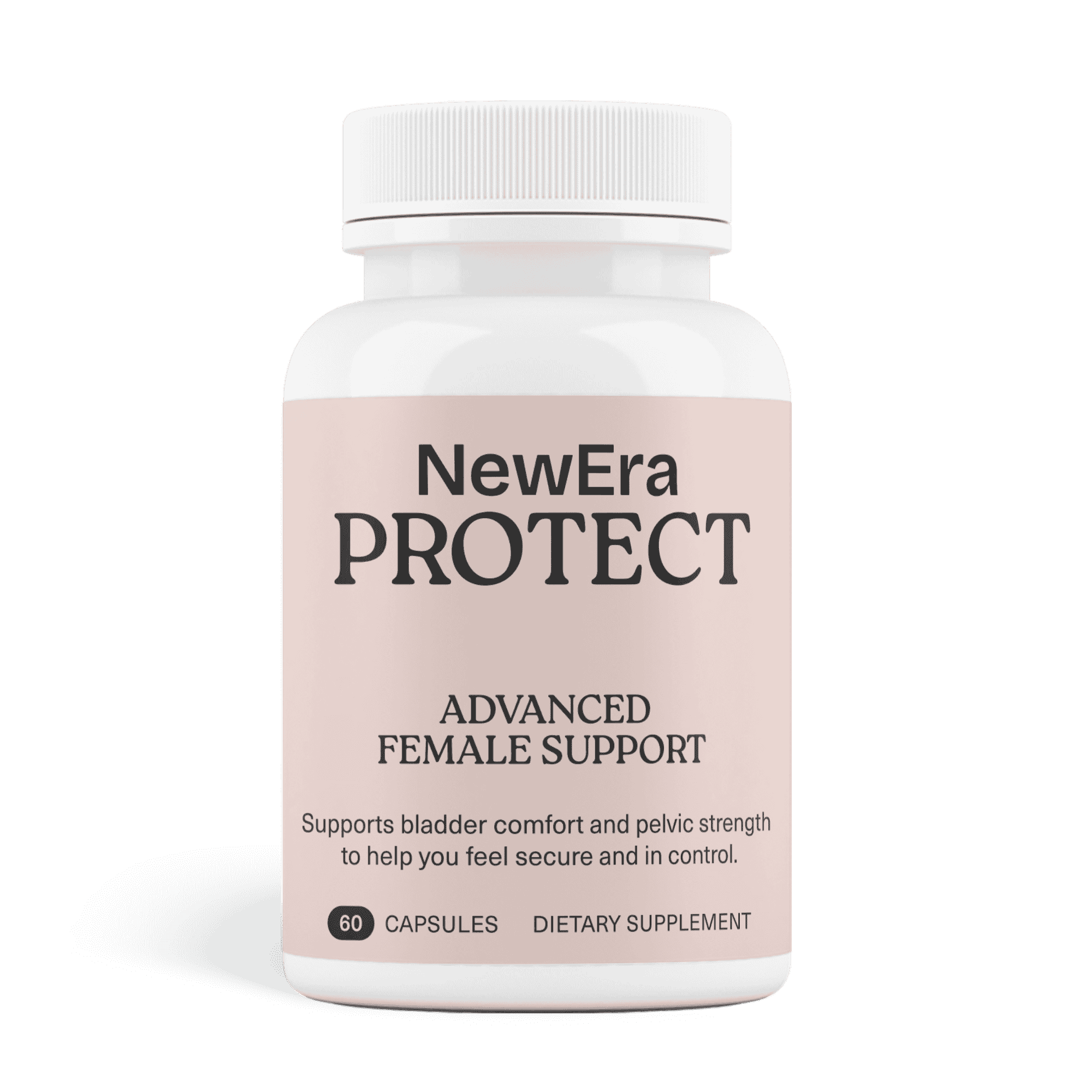
For women looking for additional nutritional support for healthy bladder and urinary tract function, NewEra Protect was formulated to complement healthy lifestyle habits with targeted ingredients.*
It's not a replacement for pelvic floor training, physical therapy, or medical care.
Instead, I like to think about bladder health as part of a bigger picture.
We support our muscles.
We support our nutrition.
We support our daily habits.
And most importantly, we keep learning about our bodies.
My Biggest Wish for Women
I wish we learned about our pelvic floors much earlier.
Not after the first bladder leak.
Not after menopause.
Not after something starts bothering us.
Imagine if pelvic floor health were talked about as normally as stretching your hamstrings or strengthening your core.
Because these muscles matter.
And the more we understand our bodies, the better equipped we are to take care of them.
So if you've ever crossed your legs before a sneeze, mapped out the bathroom before going somewhere new, or wondered why your bladder suddenly seems to have a mind of its own...
Please know you're not alone.
Your pelvic floor may simply be asking for a little more attention.
And it's never too late to start giving it some.
The Bottom Line
Your pelvic floor is a group of muscles and tissues that helps support your bladder, bowel, uterus, and other pelvic organs.
It also plays an important role in bladder and bowel control, sexual function, core stability, and everyday movement.
Pregnancy, childbirth, aging, menopause, constipation, chronic coughing, and other factors can affect pelvic floor function over time.
The good news?
There are ways to support your pelvic floor at every age.
Stay active. Pay attention to your bathroom habits. Learn how these muscles contract and relax. Take care of your overall health. And don't be afraid to ask for professional help if something doesn't feel right.
Your pelvic floor has been supporting you your entire life.
Maybe it's time we gave it a little love in return.
*These statements have not been evaluated by the Food and Drug Administration. This product is not intended to diagnose, treat, cure, or prevent any disease.
Before letting you go, I do want to mention that this article is meant for educational purposes only and reflects my experience working in the pelvic health space. I am not a medical doctor, and this content is not a substitute for professional medical advice, diagnosis, or treatment. Please consult your healthcare provider before starting any new supplement or wellness routine.
With love,
Alex Miller

Alex Miller is the founder of NewEra Naturals and the creator of Pelvic Floor Strong. She has spent over a decade helping women understand and support their pelvic health naturally. Alex lives in Canada with her daughter, Linen, and is passionate about empowering women through education, movement, and simple daily support.
Read more
Let's talk about something that doesn't get nearly enough attention. Have you ever noticed that since menopause, you're making more trips to the bathroom? Maybe you suddenly feel the urge to go—ev...
Maybe you've thought about seeing a pelvic floor physical therapist. And maybe you've also thought... Do I really have to? Maybe there isn't one near you. Maybe your insurance doesn't cover it. Ma...
Leave a comment
All comments are moderated before being published.
This site is protected by hCaptcha and the hCaptcha Privacy Policy and Terms of Service apply.